Darko Milosevic, Dr.rer.nat./Dr.oec.

Please fill free to lisen music until you read blog :-)
Showing posts with label Electric vehicle. Show all posts

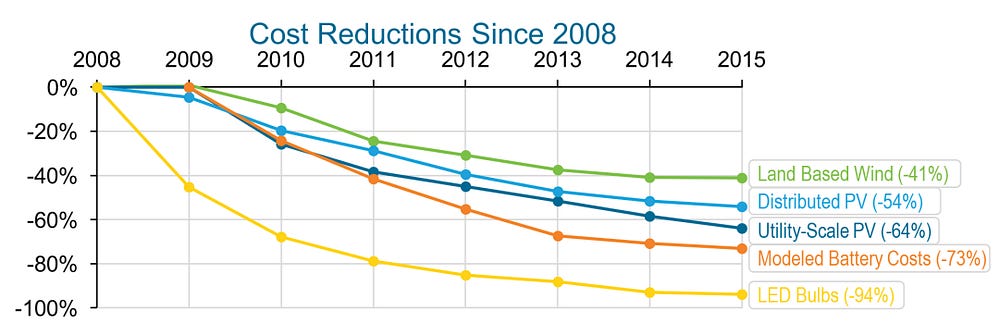
Chart of the year: ‘Incredible’ price drops jumpstart clean energy revolution

Chart of the year: ‘Incredible’ price drops jumpstart clean energy revolution

New DOE report details latest advances in solar, wind, LED lights, batteries, and electric cars.

CREDIT: Department of Energy
The U.S. Department of Energy (DOE) has released the 2016 update of its report, Revolution…Now: The Future Arrives for Five Clean Energy Technologies.
The must-read report reveals the game-changing progress core clean energy technologies have made over the last several years — specifically, solar, wind, LED lights, batteries, and electric cars. Accelerated deployment driven by smart government policies, both domestically and around the world, have created economies of scale and brought technologies down the learning curve faster than almost anyone expected.
“The clean energy revolution is too often always assumed to be something that would come along in 10 to 20 years,” Energy Secretary Earnest Moniz said Wednesday after the report’s release. “The message is: look around, it’s happening now.”
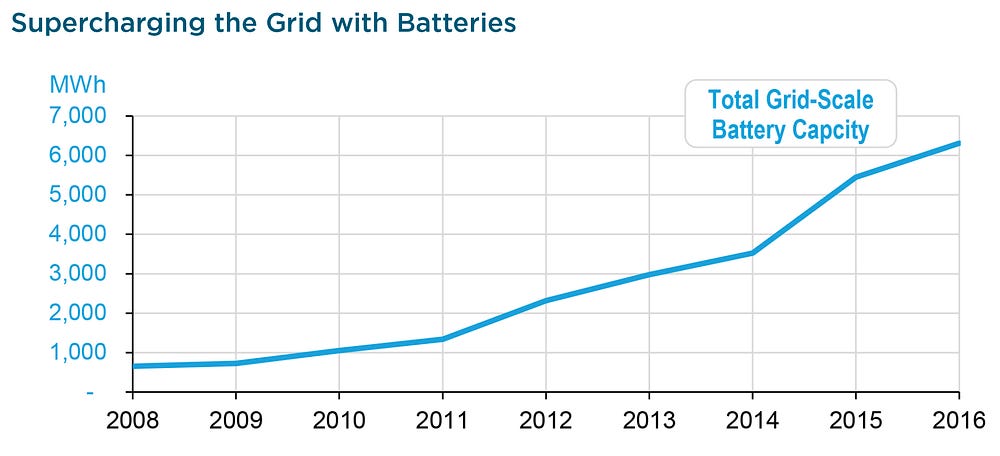
And these technologies have a very important synergy, as this chart shows:
CREDIT: Department of Energy
Batteries are helping to enable the rapidly growing penetration of variable renewable sources like wind and solar (see my May piece, “Storing the sun’s energy just got a whole lot cheaper”). The DOE report notes that “the capacity of these grid-scale batteries has increased nearly 10-fold since 2008.”
Moreover, while “the lithium-ion battery packs used in the majority of grid-connected batteries” have declined more than 70 percent in the past decade, “analysts expect both utility and consumer scale batteries to decline in cost by another 20–27 percent in just the next two years.”
As a result, DOE projects “the total domestic energy storage market could be worth $2.9 billion by 2021, as compared to $350 million in 2015.” And that’s without considering the impact of emerging super-low-cost used (“second-life”) electric car batteries, which I discussed here.
DOE calls the soaring new battery storage market “Revolution Next,” which includes such transformational technologies as smart buildings, light-weight materials, and “Big Area Additive Manufacturing” (BAAM!), better known as 3-D printing.
The next time an opponent of climate action questions the cost-effectiveness and scalability of climate solutions — or the value of government clean energy policies — the top chart and indeed the whole report should be front and center in your response.

EcoMobility

EcoMobility

From Wikipedia, the free encyclopedia
Eco-Mobility is a term used to describe travel through integrated, socially inclusive, and environmentally friendly transport options, including and integrating walking, cycling, wheeling, and passenging. By enabling citizens and organizations to access goods, services, and information in a sustainable manner, it supports citizens’ quality of life, increases travel choices, and promotes social cohesion.[1]
It is neither a new kind of transportation nor is it a collective word to indicate heterogeneous transport. EcoMobility indicates a new approach to mobility that highlights the importance of public and non-motorized transport and promotes an integrated use of all modes in a city. Environmentally sustainable and socially inclusive, ecological mobile transport choices have low to no emission compared to the personal automobiles powered by fossil fuels. It supports the use of light electric vehicles, provided that the source of the electricity is from renewable energy sources. Incorporating Ecomobility into the development of traffic systems and policies will benefit local governments in attaining international recognition for the city and its leadership.

Hypermobility (travel)

From Wikipedia, the free encyclopedia
Hypermobile travelers are "highly mobile individuals" who take "frequent trips, often over great distances." They "account for a large share of the overall kilometres travelled, especially by air."[1] These people contribute significantly to the overall amount of airmiles flown within a given society.[2] Although concerns over hypermobility apply to several modes of transport, the environmental impact of aviation and especially its greenhouse gas emissions have brought particular focus on flying.[3][4] Among the reasons for this focus is that these emissions, because they are made at high altitude, have a climate impact that is leveraged by a factor commonly estimated to be 2.7 higher than the same emissions if made at ground-level.[5]
Although the amount of time people have spent in motion has remained constant since 1950, the shift from feet and bicycles to cars and planes has increased the speed of travel fivefold.[6] This results in the twin effects of wider and shallower regions of social activity around each person (further exacerbated by electronic communication which can be seen as a form of virtual mobility), and a degradation of the social and physical environment brought about by the high speed traffic (as theorised by urban designer Donald Appleyard).
The changes are brought about locally due to the use of cars and motorways, and internationally by aeroplanes. Some of the social threats of hypermobility include:[7]
The addictive properties of hypermobile travel have been noted by researchers.[8][9][10][11][12]
Widespread Internet use is seen as a contributory factor towards hypermobility due to the increased ease which it enables travel to be desired and organized.[13] To the extent that the Internet perversely stimulates travel, it represents a lost opportunity to reduce overall emissions because online communication is a straightforward substitute for physical travel.[14]
The term hypermobility arose around 1980 concerning the flow of capital,[15] and since the early 1990s has also referred to excessive travel. [See: Hepworth and Ducatel (1992);[16] Whitelegg (1993);[17] Lowe (1994);[18] van der Stoep (1995);[19] Shields (1996);[20] Cox (1997);[21] Adams (1999);[22] Khisty and Zeitler (2001);[23] Gössling et al. (2009);[1] Mander & Randles (2009);[24] and (Higham 2014).[8]] The term is widely credited as having been coined by Adams (1999), but apart from the title of the work it says nothing explicit about it except that "[t]he term hypermobility is used in this essay to suggest that it may be possible to have too much of a good thing."[1][22]

The EU needs to regulate for cities with driverless cars – Dr Jean-Luc di Paola-Galloni

The EU needs to regulate for cities with driverless cars – Dr Jean-Luc di Paola-Galloni

Dr Jean-Luc Di Paola-Galloni says that regulation of automated cars needs to be harmonised throughout Europe. Image courtesy of Dr Di Paola-Galloni
Driverless cars may sound like something out of a sci-fi movie, but according to Dr Jean-Luc Di Paola-Galloni, co-chairman of the European Road Transport Advisory Council (ERTRAC), they could be on our roads in just four years’ time, and so the EU needs to regulate that.
What do we mean by automated cars, and why do we need them?
‘There are some functions of transport that don’t need to be done manually by drivers. Driving in a congested environment is not pleasant at all. If the vehicle can move (semi-) automatically, then this is much better. And it’s not just better in terms of comfort, it is in particular better in terms of safety and in terms of traffic management optimisation.’
One of the main justifications for automated cars is that they are safer, but how so?
‘The very first automated devices in the car industry were introduced because of safety. For example, you have an automated signal in the car if you forget to put your seatbelt on. And the European Commission has been involved in the eCall (where the car calls the emergency services after an accident) - this is very important because it has saved lives. Automation is the natural daughter of decades of safety research.
‘Automation will also reduce congestion. It will allow traffic to use lanes more effectively, and it will lead to substantial energy and fuel savings.’
There are already some test areas where automated systems are in place under controlled conditions, such as in La Rochelle, France or in Wimbledon, London, UK. What differences do you expect to see in the years to come?
‘The testing areas exist already as of now. Some are going to be announced and developed really in two or three years to come. We know that out of these tests we will get things that are working and things that are not working, as is always the case during tests. What will happen is that the successful technologies will be progressively spread from these test areas to other areas.’
When do you think that the technology will be widely available?
‘All the different experts, whether they come from the industry, whether they come from a more philosophical or societal background, will tell you that the very first proper automated car will be running within the next three years.’
‘My hope is really that the consumer, the user will become beneficiary of these new aspects of integrated and more inclusive road mobility.’
Dr Jean-Luc di Paola-Galloni, co-chairman of ERTRAC and Vice-President of Valeo
What is the role of ERTRAC in these automated transport systems, where cars will drive themselves?
‘We bring advice to the Commission on what the Commission should implement in the end as common research projects. We are now in the final process of delivering a roadmap to the Commission on this topic. And obviously to highlight that Europe should sustain the financial and research efforts of all the public, private, industrial and non-industrial stakeholders.
‘What we need the most now is a harmonisation of the different regulations across Europe.’
What about traffic grids, traffic management systems – how will the EU regulate and legislate for these?
‘This is exactly one of the issues that the roadmap highlights. The main question is what are the best connections within the (transport) grid – the technological dialogue between the car and the grid, the cars and the infrastructure, and between traffic management systems and the vehicles – in order to ensure the best possible outcome?’
What do you think is the biggest challenge that faces you in the coming years? And your main hopes?
‘For sure it’s all the harmonisation and standardisation work to be done. This is a clear challenge.
‘My hope is really that the consumer, the user, will become the beneficiary of these new aspects of integrated and more inclusive road mobility.’
More info

Self-braking cars ‘in five years’

Self-braking cars ‘in five years’

In trials, the technology has had a 100 % success rate. Image courtesy of ARTRAC
Self-driving cars have been stealing all the media attention. But another revolution in car technology is underway and largely going under-reported.
Cars that can automatically detect pedestrians and cyclists and are able to brake before they hit them could be saving many lives in the near future. They could also help meet theEuropean Commission’s target of halving road accidents by 2020.
‘It is a big scandal that we accept that every year 5 000 people die on German roads,’ said Professor Hermann Rohling, from the Institute of Communications of the Hamburg University of Technology, Germany. ‘That would not be accepted in air traffic.’
He coordinates a European research project which has developed a system that can detect, classify and avoid obstacles on the road before collision.
Sixth sense
The ARTRAC project, which includes carmakers Volkswagen and Fiat, developed an affordable radar sensor that uses multiple antennas that can give the car a sort of sixth sense.
‘There was not a single instance of a radar sensor not working properly.’
Professor Hermann Rohling, Hamburg University of Technology, Germany
Once it detects a pedestrian, it can give out a warning or even be linked to an automatic braking and steering system.
Radar was chosen because it is relatively cheap, robust and can work just as well in bad weather and even at night.
The system worked properly during more than 100 trials. ‘Even for me, that was really a surprise – that there was not a single instance of a radar sensor not working properly,’ Prof. Rohling said.
The prototypes developed by the EU-funded project are now under review before they get tested in-car. But Prof. Rohling expects to see them in commercially available cars soon, within the next five years, together with emergency braking systems to prevent collisions.
If it is implemented, he says, there is no doubt that the number of fatalities, especially those of pedestrians and cyclists being hit by cars in our cities, will go down.
This is where another EU-funded research project, ASPECSS, which finished in 2014, is helping. It worked out how to test and evaluate the efficacy of these autonomous emergency braking systems in order to develop consumer ratings and stimulate widespread introduction.
The ASPECSS researchers also established a basis for testing automatic braking systems designed to protect cyclists, in anticipation of this technology becoming commercially available in the near future.
Romania had the highest number of road deaths in 2013 with 93 fatalities per million inhabitants, whereas Sweden's roads were the safest with 27 deaths per million. 

Advice on CO2 vehicle emissions testing in six months – EU science panel’s Dr Henrik C. Wegener

Advice on CO2 vehicle emissions testing in six months – EU science panel’s Dr Henrik C. Wegener

Dr Henrik C. Wegener is the chair of the EU's Scientific Advice Mechanism, which for its first task will provide advice on how to measure CO2 emissions with greater real-world accuracy. Image courtesy of Dr Wegener
The EU’s new Scientific Advice Mechanism (SAM) panel will deliver its first official advice to the European Commission – on how to close the gap between vehicle CO2 emission levels in the real world and those detected under test conditions – within six months, according to Dr Henrik C. Wegener, Chief Academic Officer at the Technical University of Denmark, and chair of the SAM High Level Group.

After your first meeting of the panel on 29 January you’ve been tasked with providing advice on two topics: CO2 emissions from vehicles and cybersecurity. Was the public interest in the Volkswagen emissions scandal a factor in choosing this topic?
‘(There was) certainly a strong desire from the (European) Commission to have work carried out in this area at this time but we should keep in mind that the topic SAM is studying is very different to the Volkswagen scandal which was related to air pollutant emissions. Our topic is focussing on CO2, which is a very different issue. In the evaluation of what topics to take on board, we also look at what is the timing relative to the need to develop and implement specific policies, so that our advice comes at the right time.
‘But we are obviously also developing our practices and procedures as we engage in the first topics. That’s part of the reason we chose two topics that are quite different in nature and also different in how broad they are and what scientific disciplines should be considered when answering the questions.’
What kind of questions are you looking at in CO2 emissions from vehicles?
‘The questions relate to improving the measurements of CO2 emissions so they more closely resemble real-world emissions than what is currently the situation. That analysis includes also looking at which approaches can be used, are there any science arguments that need to be considered, and basically also in what kind of framework (or) system this could be done to ensure the best possible transparency and general reliability.’
What’s the timeframe for your advice?
‘We have not committed to a specific date but we have a mutual understanding that we would like to arrive at a conclusion on the CO2 emissions issue within half a year. For cybersecurity, it will take a little longer.’
What are you looking at with cybersecurity?
‘One of the issues that is of particular interest and expressed in the scoping paper is single digital identities management in Europe. How do we create the single digital market and how can we make sure that cybersecurity issues do not get in the way or jeopardise the ambition to develop that? Another prominent question is the issue of encryption – on one side to ensure that our personal and private data are encrypted, but on the other side how do we ensure that those who need to be able to follow communication or traffic of data to protect our societies also have these opportunities? So the back door question.’
How did you come up with the topics?
'It was an iterative process based on a large pool of potential ideas that had been indicated by different Commissioners as being potential areas of SAM engagement. I believe that those Commissioners indicated to Commissioner Moedas which topics were the most appropriate to be investigated by SAM, based on a combination of their relevance to the policy priorities of the Juncker Commission and the timeliness of the advice that would be provided. According to the rules setting up the High Level Group, we can also bring topics to the attention of the Commission that we think will be important for future policy development, and we are continuing to reflect on potential topics. 
How will SAM work? 
‘We would like to arrive at a conclusion on the CO2 emissions issue within half a year.’
Dr Henrik C. Wegener, chair of the SAM High Level Group
‘We are not going to do any research of our own. The starting point is all the evidence that is out there. We have to create mechanisms so that it is somehow collected, collated and put into the policy context in which it should benefit EU regulation, to provide better scientific evidence for improved regulation.
‘As you know we have had our first meeting, we have taken on the topics. In the next meeting (we continued) conversations on how we are going to go about delivering the science-based advice. So far we’ve met with the Joint Research Centre (the EU’s in-house science body) and discussed with them both topics. But we should involve all relevant science providers, experts, and the academies. We are structuring that at the moment, but we haven’t found the final formula for it.’
How can SAM play a role in encouraging evidence-based policymaking?
‘Clearly the establishment of SAM represents a very formal and tangible commitment on the side of the (European) Commission to ensure access to scientific advice for policymaking. And now we have to develop a system that delivers exactly that. The SAM High Level Group consists of experienced scientists from a reasonably wide range of scientific disciplines so we represent a multidisciplinary scientific view on the questions. We should and we will establish links to the broader European and global scientific community to solicit scientific input which we then interpret and convey back to the Commission (and) the Commissioner.’
How will you know if you’re doing a good job?
'If our input improves policymaking so that it is based on the best available scientific evidence and thereby we get better policies or regulations, that of course is one important endpoint. Another thing which I think is interesting is if the establishment of SAM can somehow facilitate a structuring of the landscape of the academies so that they play a more active part in providing scientific advice, scientific input to policymaking both at an EU level but also, in many Member States, at the national level. This is done very differently in the different Member States and I think when I look at the way it works in the US and also maybe in other areas, the European system has a lot more to offer than what I think right now is being utilised.’
What is the benefit of having a team of advisors, rather than a single person?
‘A group clearly has many benefits when you are asked to deliver specific science-based advice on very complex questions. We have already been asked questions about two issues on which none of us is a specialist. Being in a group means that we can have seven minds looking at evidence, identifying the key people to speak to, and seven minds unpicking the complexities of these scientific areas. Of course, there’s the risk that we’ll disagree, but for me that is a crucial check and balance when we’re talking about providing scientific advice for policy making.’

Conference on science advice to government

The Scientific Advice Mechanism will be presented to the international community at the second International Network for Government Science Advice conference, which will be held in Brussels, Belgium on 29 and 30 September 2016 and is co-organised by the European Commission.
The conference will explore how to deepen the dialogue between science and policymaking, how to ensure policymakers have access to timely, solution-oriented advice and how to work across international boundaries.
More information can be found at https://ec.europa.eu/research/sam/index.cfm?pg=events.
More info
 
CONTACT FORM
Please fill contact form in details:
Name and surname:  *
E-mail:  *
Telephone:  *
Arrival:  *
Check out:  *
Number of Persons:  *
Accommodation Type:
Price:
Destination:  *
Business Sector:
Subject:  *
Wishes and comments:
 
 
 *Must be filled with fields.